One journey, multiple services — 50% more efficient design & development


The brief
- Maintain our competitive edge with other Telcos for acquisition.
- Faster time to market with a common customer journey that can be adopted by different segments.
- Seamless integration to existing systems and customer journey.
- Be prepared for when iPhone launch eSIM-only device.
- Reduce calls and cost to customer care center.
Goal
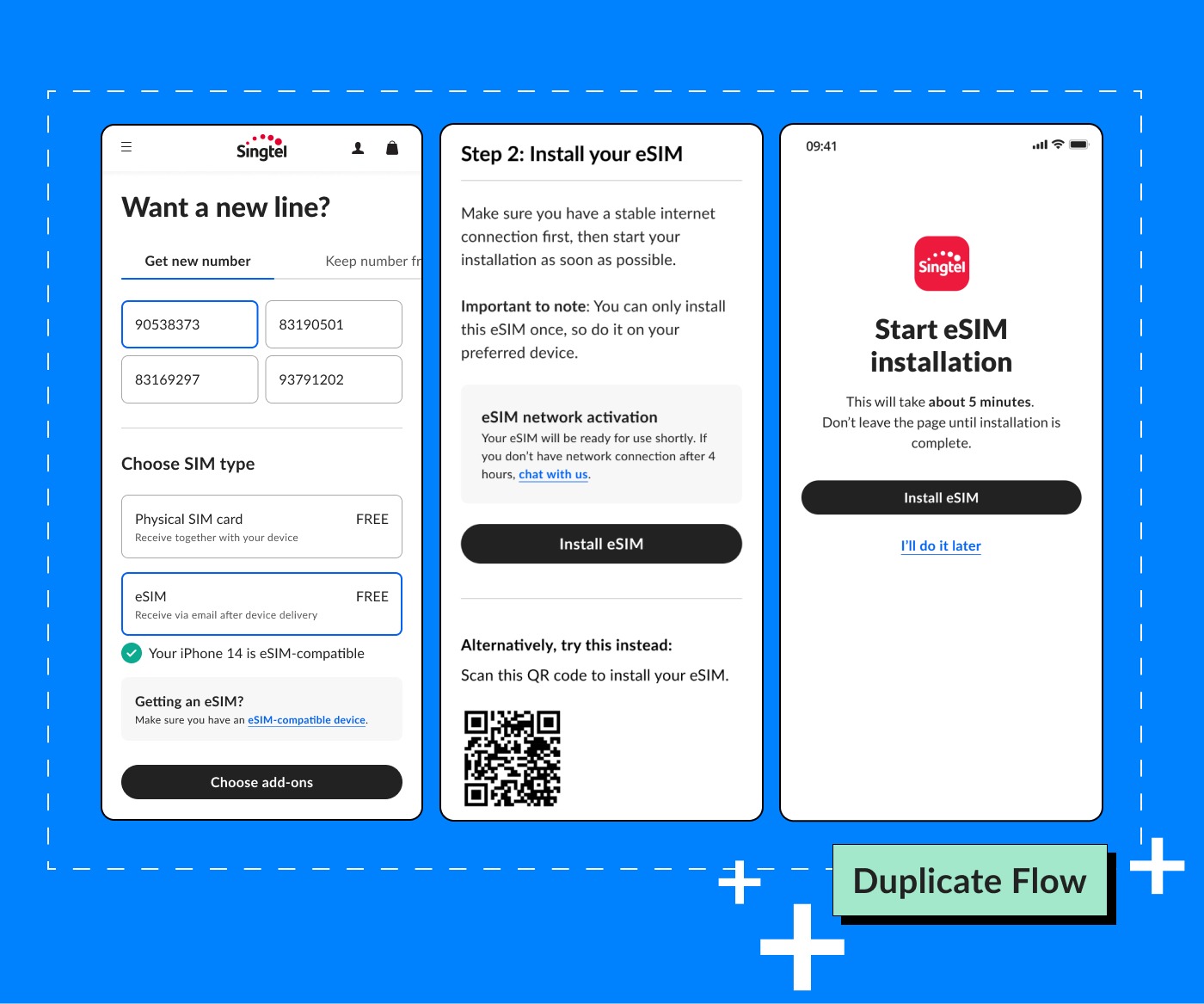
In a big organisation that handles multiple services, there’s potential to create synergy across all these services to ensure a seamless customer journey. Hence the importance of creating one experience that can be reused across all eSIM projects in the organisation.
Achievements
- Awarded “Award of Excellence” in Singtel Group IT 2024 for outstanding contribution as part of Gomo-eSIM & Postpaid-eSIM
-
Reduced 50% time to re-design and develop – adapted across Postpaid, Gomo, Prepaid, and Enterprise projects
-
67.6% take-up rate for GOMO eSIM
- Potential cost savings of up to 80% per user in SIM card delivery and production, totalling over $128k savings
Project duration
2023, 3.5months
My role
Design lead with a team of 4
Key skills
- Research
- User experience
- Design system
- Service design

✏️ Takeaway #1
Creating a common journey is not a silo job
Always document the roles and goals, especially working with a big team
This project involved over 20 stakeholders from units across product development, operations, network, IT, marketing, and design. Things can get messy if roles and responsibilities are not set clearly. People will constantly approach the wrong person for discussion and decision-making, which can also detract us from our goal.

⬆ Above: We used Confluence to keep a living document for our roles, goals and meeting notes.
Other processes were introduced to ensure that the eSIM journey can be delivered on time.
Weekly team meeting
Time block for the working level to call out blockers and provide progress updates.
Team group chat
An avenue for addressing urgent issues and obtaining clarifications, ensuring that everyone is informed and can receive support more quickly.
Weekly design team meeting
Time block for designers to ensure team alignment from an experience perspective, before meeting stakeholders.
Build a design blueprint to ensure consistent experience is documented

⬆ Above: Imagine customers have to go through another learning curve to compare services from the same company
- Helps to provide clear direction and align everyone around a shared vision for the user experience.
- Maintain consistency and standards across similar flow for Singtel customers regardless of which services (Postpaid, Gomo, Prepaid, Enterprise) the customer switched to.
- Reduce time and cost to build the same journey, allowing quicker go-to-market.
Don't forget your designer peers and buy them coffee (or tea)
They are the end users for the design blueprint and your best support. They have the expertise to assist you in addressing all the possible scenarios.
In a nutshell, these are what I included as part of the process:
- Communicate – the idea to create a design blueprint with designers.
- Engage – with designers to understand the current physical SIM purchase flow and the gaps they usually face.

⬆ Above: Landscape analysis across current Singtel services with common areas identified for improvement.
- Design critique sessions – to get feedback and alignment for the blueprint.
- Divide and conquer – work with designers on a timeline for them to help adopt your blueprint design with their project UI.

⬆ Above: Work with designers and copywriter to come up with a design timeline for visibility.
✏️ Takeaway #2
Design beyond Figma – include system mapping and communication channels
As designers, we often limit our designs to Figma screens and fail to document anything beyond what our team creates. This has resulted in a lack of complete visibility into a customer’s journey from purchase to post-purchase. This was discovered during my landscape analysis with designers. The biggest gap identified was in customer communications, which has many unknowns and could create uncertainty for customers.

⬆ Above: Key gaps revolve around when will users be informed and what is communicated.
Lack of visibility into post-purchase communications and network provisioning
It was challenging to include all the information I had hoped for. Most of the communications were decided without involving our design team beforehand. It took some time to reach out to the right team members to help verify the scenario mapping and content.
⬇ Below: Using a table to create scenario mapping helps to clarify the email templates to be created and developed.

During the search, we uncovered additional issues that need to be considered for the design blueprint. For example, it is important always to ensure that customers are aware of what will happen to their current SIM card during the network activation process for their new eSIM. This will help reduce costs and the number of calls to customer care.
The lack of visibility to post-purchase communications also impacted our support pages, leading to inaccurate content and miscommunication. By involving our content writer and researcher, we outline what users want to know based on past insights and then we did a sorted the information architecture based on our key user flows.

⬆ Above: Using FigJam to brainstorm the information architecture for our eSIM support pages.
Limitations to our customer billing platform
To ensure a smooth integration into our current systems and customer journey, it was crucial to involve the IT solution designer and platform owner in our UX discussion at every stage. This was necessary due to the additional costs and complexity that would incur to enhance our older systems, which made it unappealing to develop a separate fulfilment process for eSIM.

⬆ Above: Whiteboarding galore with IT solution designer and platform owner.
🙌🏼 Sharing is caring
After putting in a lot of effort to compile all the findings, what’s the use of keeping it just for this project? Sharing this knowledge with the design team help breaks down the siloes designers tend to put up while working on their projects separately. Now, everyone including content writers and researchers will have more visibility into the complete customer journey.

⬆ Above: A consolidation of all the SMS sent out post-purchase, this was also the perfect opportunity to streamline the copy in our existing SMS
✏️ Takeaway #3
Always test your flow – nothing is perfect!
Since purchasing an eSIM is primarily an online self-assist process without any in-person staff to assist customers, it’s crucial to ensure that customers can easily navigate the entire process on their own. After designing the initial flow, I enlisted the help of our researcher to conduct a usability test.
Objective:
How do we get users from considering to installing an eSIM confidently, without needing additional support?
Participants:
Moderated usability Test with 13 non-eSIM users
(We chose users who are unfamiliar with eSIM so that we can identify where support is needed most.)
Key results:
- Address knowledge gaps to customers – benefits of eSIM and fears such as network disruption and independently navigating eSIM installation and management.
- Provide more clarity on how eSIM will be delivered to users.
- Reduce back-and-forth switch between platforms to install and activate eSIM. Focus only on the information needed at each step. Omit a separate step for activation.
Design iteration
As much as I would like to incorporate all the design recommendations from research, realistically, we do have time and system limitations. As a team, we aligned for the first phase to work on low-hanging updates and the rest to leave at a later phase.

⬆ Above: Design iteration based on research findings, most were copy changes with some UI updates
To summarise
- Build a design blueprint to ensure consistent experience is captured across projects.
- Creating a common journey is not a silo job. It is a collaborative effort and communication is important.
- Design beyond Figma – incorporate system mapping and communication channels to gain a comprehensive understanding of the customer journey.
⬇ Below: Here's what the final adaptation looks like!
